Remote Controlled Animatronics can turn a quiet room into a scene with movement, sound, and a little theatrical surprise. But the right choice depends on more than a dramatic appearance. Size, control range, movement options, power needs, setup time, and durability can all affect how well a model suits a home, display, event, or collection.
This guide explores seven options and the features that distinguish them. It considers what buyers can verify in product specifications, such as control methods, materials, and stated operating requirements. Those details matter. A creature with sweeping motions may look impressive, while a smaller figure could be easier to store and operate. Neither is automatically better. Without consistent hands-on testing, product claims should be treated as information to check, not proof of real-world performance.
Think about the space where the animatronic will stand. Will its movements fit without striking nearby furniture? Is the controller easy to use from the intended viewing distance? Small details matter. So does maintenance. This comparison aims to make those trade-offs easier to see, while recognizing that a feature-rich model may still disappoint if it does not fit your setup. The best choice is the one whose performance, practical demands, and price align with your needs. That can be less exciting than choosing by appearance alone, but it is often the wiser place to start.
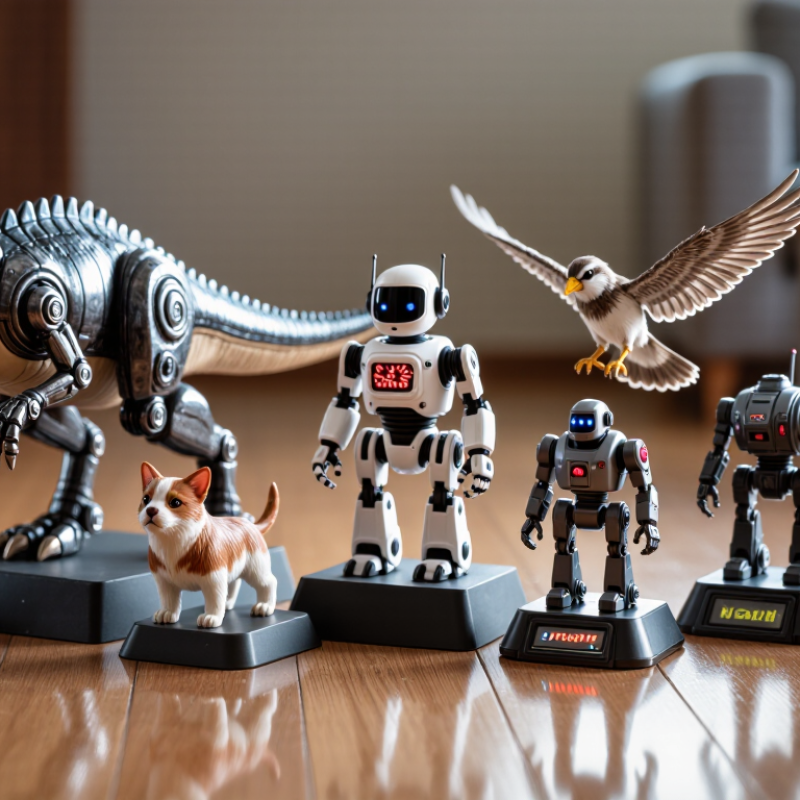
Remote-controlled animatronics are defined by how an operator directs them, what their mechanisms can move, and where they are used.
Control may come from a handheld radio transmitter, a wired console, or a phone-based interface. Radio control allows movement across a stage or display area; a cable can provide steadier input nearby. Check the control range, response delay, and available channels before choosing. Small details matter: a jaw that moves independently feels different from a head that only turns.
Motion ranges from simple gestures to coordinated sequences. A compact figure might blink, nod, and raise one arm, while a larger installation may combine head turns, torso movement, and sound cues.
Intended use narrows the choice: tabletop displays need compact, repeatable actions; live attractions may need stronger mechanisms and easier operator access.
The International Federation of Robotics reported 541,302 industrial robots installed worldwide in 2023 in its World Robotics 2024 report. That figure is not an animatronics count, but it illustrates the wider growth of programmable motion.
A limitation remains: product descriptions often say “full motion” without explaining which joints move. Ask for a motion list, operating time, and setup requirements.
It is easy to overlook maintenance. A loose connector can spoil a good performance.
A fair ranking of seven remote-controlled animatronics should start with published servo torque, runtime, and control range—not appearance or promotional claims. Torque figures need units and test conditions: a servo’s stall torque does not describe its strength while moving a costume jaw repeatedly. Runtime also depends on battery capacity, payload, and movement frequency. Control range should specify the test environment; walls and radio interference can shorten it. Details matter.
There is no widely accepted industry report ranking consumer animatronics across all three measures. The International Federation of Robotics’ World Robotics 2024 report counted 4,281,585 industrial robots operating in factories in 2023, but that figure does not validate toy-scale servo claims. ISO 9283 provides performance-testing guidance for industrial robots, not a direct rating method for remote-controlled figures. A useful seven-model table should therefore cite each product’s technical sheet and mark missing data as “not published,” rather than guess. I would rank verified torque first, then runtime, then tested range. That weighting is imperfect. A powerful servo may drain a small battery quickly, while a long-range controller cannot compensate for a sluggish mechanism. Raw numbers need context.
For the seven leading remote-controlled animatronic types—head-and-neck units, expressive torsos, tails, wings, full-body figures, puppet-style rigs, and multi-character systems—degrees of freedom (DOF) offer a useful first comparison. A jaw-and-eye unit may have only a few independently controlled motions; a full-body figure can coordinate many joints. More DOF can make a creature turn, blink, and gesture together, but only when the controller keeps those movements smooth. Watch the shoulders and jaw during a slow sweep. Jerks show.
ISO 9283 defines performance measures for industrial robots, including pose accuracy and repeatability, but it is not an animatronics ranking standard. Use it as a measurement reference, not proof that one product is superior. For durability, compare cycles to failure under stated load, speed, temperature, and maintenance conditions. The International Federation of Robotics reported 4,281,585 industrial robots in operation worldwide in 2023 (World Robotics 2024); that figure shows the scale of robotics, not animatronic service life. Ask for test logs. A cycle should include the same movement sequence each time, with failures and repairs recorded. Published cycle-life claims are hard to compare when test conditions differ. I would discount impressive numbers without a clear protocol; even careful logs leave some uncertainty.
What Are the 7 Best Remote Controlled Animatronics?
Check Safety Against ASTM F963 and Wireless Operation Under FCC Part 15
A remote-controlled animatronic should move convincingly without creating avoidable hazards. Check the age grading, exposed joints, loose parts, and battery compartment before comparing features. Fingers can reach small gaps. Look for pinch points around moving jaws, arms, and wheels. ASTM F963 sets U.S. toy safety requirements, including tests for mechanical and physical hazards. Ask sellers for applicable compliance documentation, rather than relying on a safety claim in a product description.
The U.S. Consumer Product Safety Commission’s 2023 Toy-Related Deaths and Injuries report estimated 209,500 toy-related emergency-department injuries among children 14 and younger in 2022. That figure covers toys broadly, not animatronics alone, but it is a useful reminder to inspect construction and supervise play. Small details matter. Tug gently at accessories, check seams, and confirm batteries cannot be accessed easily by young children.
Wireless controls deserve equal attention. Under FCC Part 15, devices must not cause harmful interference and must accept interference they receive. Check the unit’s compliance information and test the controller in the room where it will be used. Notice delayed commands, unexpected movement, or lost connection near other electronics. Range is not everything. I would still retest after changing batteries; that simple check is easy to overlook.
The options below are general product types, not named or independently tested products. Use the checks to compare individual toys; safety and wireless compliance depend on the specific product and its documentation.
| Remote-Controlled Animatronic Type | Best Fit | Typical Control Consideration | ASTM F963 Safety Check | FCC Part 15 Wireless Check |
|---|---|---|---|---|
| Walking dinosaur figure | Children interested in moving creature toys and simple play routines | Check the stated control range and whether the controller uses infrared or radio-frequency transmission. | Confirm the age grading, warnings, and applicable toy-safety compliance information. Inspect for accessible small parts, pinch points, and battery-compartment security. | For a radio-controlled version, look for the required FCC compliance information in the product documentation or on the device, as applicable. |
| Remote-controlled robotic pet | Interactive pretend play with movement or sound responses | Check whether movement and sound are controlled by the handset, sensors, or both. | Review age recommendations and instructions; check accessible moving parts, sound-related warnings, and battery access. | Determine whether the wireless link is radio-frequency or infrared. FCC Part 15 applies to relevant radio-frequency devices, not to toy safety. |
| Tabletop creature with moving head or limbs | Display-style play in a supervised indoor setting | Check whether the remote requires direct line of sight, which is common for infrared control. | Check stability, moving-part gaps, material and age-related warnings, and the instructions for safe placement. | If the remote uses radio frequency, review the supplied FCC Part 15 statement and any applicable device identification information. |
| Remote-operated dinosaur or creature puppet | Imaginative play and simple performance-style movement | Check how the controller is held and whether the toy’s motion is controlled by a wired or wireless handset. | Check seams, attachments, cords or straps, and any small components against the stated age range and warnings. | For wireless radio operation, confirm that the product documentation addresses applicable FCC Part 15 requirements. |
| Roaring or sound-and-motion creature figure | Play that combines movement with sound effects | Check whether sound can be turned off or adjusted and whether the remote controls sound separately from motion. | Read sound, battery, and age warnings; confirm the product’s safety information covers its intended use. | FCC Part 15 concerns radio-frequency emissions and operation; it does not establish acoustic or general toy-safety performance. |
| Large floor-running animatronic figure | Open indoor play areas with room for movement | Check the stated operating surface, turning space, battery type, and control range. | Review stability, accessible moving mechanisms, battery security, and age grading. Keep use within the manufacturer’s instructions. | For an RF remote, check the model-specific compliance information rather than assuming all products in this category use the same radio system. |
| Multi-action remote-controlled creature | Users seeking several separately controlled motions or play functions | Check the control layout, required batteries, and whether the remote can operate more than one compatible toy. | Review the instructions and warnings for each function, including moving parts, battery handling, and the intended age range. | Check the documentation for the specific transmitter and receiver. FCC Part 15 compliance does not mean the product has been approved as safe under ASTM F963. |
How to verify: ASTM F963 is a U.S. toy-safety standard covering applicable toy hazards; the relevant edition and requirements depend on the product and its intended use. FCC Part 15 addresses applicable radio-frequency devices and their operation, not mechanical, chemical, or other toy-safety hazards. Check the exact product’s packaging, instructions, and compliance documentation before purchase.
For collectors, the best remote-controlled animatronic is compact, quiet, and easy to pose on a shelf. Look for smooth head turns, expressive eyes, and a controller that works reliably across a room.
Educational models should expose their mechanics: visible linkages, replaceable parts, and simple movement programs help learners connect motion with engineering. Keep the setup hands-on. That matters.
For film work, prioritize repeatable movements, adjustable speed, and controls that operators can use off-camera. The U.S. Bureau of Labor Statistics projects 4% employment growth for special effects artists and animators from 2023 to 2033, a useful reminder that production skills remain relevant, though the figure does not measure animatronics specifically.
For live performance, choose a sturdier creature with quieter motors, secure cable management, and gestures readable from the back row. TEA and AECOM reported 244.6 million visits to the world’s top 25 theme parks in 2023, underscoring the scale of audiences that themed entertainment can reach.
The remaining picks suit different needs: a tabletop character for beginners, a modular museum figure for repeated demonstrations, and a lightweight stage puppet for touring shows. Match the machine to its setting, not just its movement count.
A dramatic jaw snap may look impressive in a video, yet feel distracting in a classroom. I would test the controller under real lighting and noise. Remote systems can misbehave.
The right choice balances repairability, safe operation, and the story each movement tells.