Choosing metal exterior doors for global projects requires more than comparing finishes, prices, and catalogue photographs. Climate, security expectations, accessibility, fire performance, and local installation skills can change the correct specification. A door that performs well beside a dry warehouse may fail near a humid coastline. Salt can attack unprotected hardware. Dust can enter poorly sealed thresholds. Small details matter.
As door and hardware consultant Gary M. Kessler explains, “A door is only as reliable as its frame, hardware, and installation.” This practical view should guide every project team. Metal exterior doors need compatible frames, tested seals, corrosion-resistant hinges, and hardware suited to daily traffic. Confirm opening sizes on site. Drawings are not always accurate. That mistake is easy to underestimate.
A global specification should also examine thermal movement, drainage, wind exposure, and replacement access. Stainless steel, galvanized steel, and aluminum each behave differently. The cheapest option may create higher maintenance costs later. Sometimes, the first choice is wrong.
Experience should remain visible in the process. Ask suppliers for test evidence, coating details, warranty limits, and project references in similar environments. Review mock-ups under real lighting and weather conditions. Check how the threshold meets paving, waterproofing, and interior floors. These decisions may seem ordinary, yet they shape comfort, safety, and service life.
There is no universal door. A reliable selection balances performance, local knowledge, and honest review of project risks. Be willing to revise the specification before production. That restraint often protects the budget and the building.
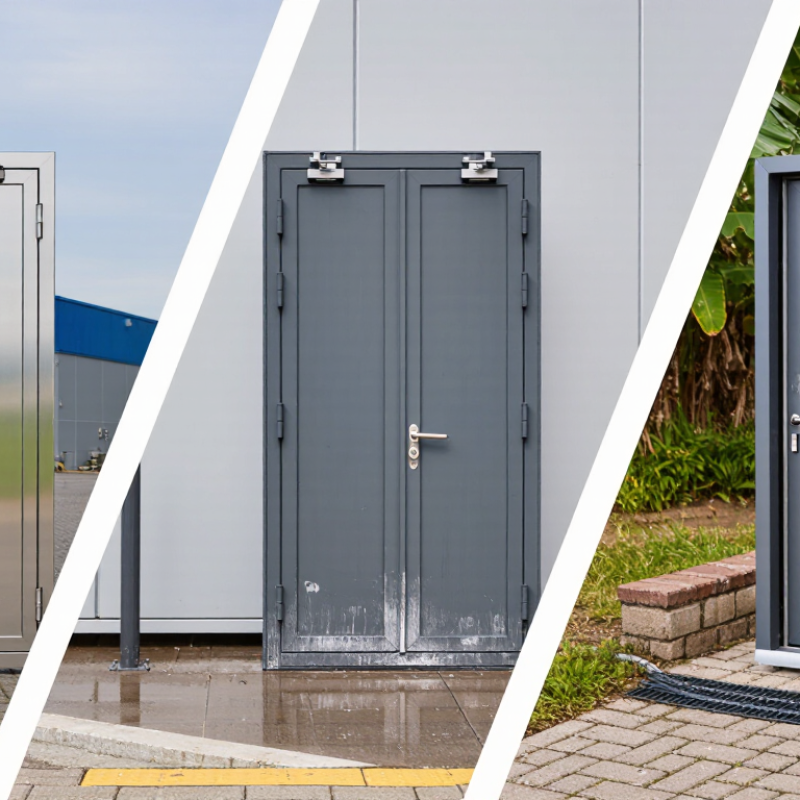
How to Choose Metal Exterior Doors for Global Projects?
Every market needs its own climate brief. The World Meteorological Organization reported that 2023 was approximately 1.45°C above the pre-industrial average. That matters at the doorway. Hot climates demand stable seals, solar-resistant finishes, and controlled thermal movement. Cold regions require tested insulation, drainage, and protection against freeze-thaw cycles. Coastal sites need corrosion-resistant steel, sealed hardware, and coating systems tested for salt exposure. Monsoon zones need sloped thresholds and reliable water management. Small details fail first.
Security requirements should reflect local risks, not assumptions. Assess forced-entry exposure, occupancy, visibility, emergency access, and hardware availability. Where applicable, specify tested assemblies under EN 1627 or comparable regional standards. A strong leaf is not enough. The frame, hinges, locks, glass, anchors, and wall connection must perform together. Local fire regulations also influence ratings, closers, vision panels, and escape-door operation. Confirm certification before procurement, because test methods and acceptance rules vary between markets.
Performance must include energy use and daily operation. The International Energy Agency’s 2023 buildings report states that buildings consume about 30% of global energy and produce roughly 26% of energy-related emissions. A thermally broken frame, low air leakage, and an accurate U-value can reduce avoidable losses. Yet specifications sometimes exaggerate laboratory results. Check installation conditions, threshold details, maintenance capacity, and replacement lead times. A perfect global specification rarely exists. Build a market matrix, then revise it after site feedback.
For global projects, material choice should start with the load path, not appearance. Steel offers high stiffness and impact resistance, useful for wide leaves, security doors, and busy freight entrances. EN 10025-2 lists common structural steel yield strengths from 235 to 355 MPa. Its drawback is mass: ASM Handbook places carbon steel near 7.85 g/cm³. That weight increases hinge, closer, frame, and shipping demands. A missed allowance can cause sagging.
Stainless steel has similar density, about 8.0 g/cm³, according to ASM Handbook, but improves corrosion resistance. However, grade and finish matter; ASTM A240 data shows annealed 304 stainless at roughly 205 MPa yield strength. It is not automatically stronger than every carbon-steel option. Use it where salt spray, cleaning chemicals, or exposed edges challenge painted systems. Maintenance still matters.
Aluminum changes the balance. The Aluminum Association reports density near 2.70 g/cm³, making transport and manual handling easier. Common architectural alloys can deliver about 110–276 MPa yield strength, depending on temper. Aluminum usually needs thicker sections or reinforcement for similar stiffness. Do not select by metal U-value alone. U-value belongs to the complete door, with lower values indicating better thermal performance. NFRC 100 evaluates the frame, glazing, thermal breaks, and seals together. A thermally broken aluminum frame may outperform an unbroken steel frame, while poor seals can undermine both. I would verify tested whole-door U-value, air leakage, and condensation risk for the actual size. That step is less glamorous, but it prevents expensive surprises.
How to Choose Metal Exterior Doors for Global Projects?
Metal exterior doors should be tested, not selected by appearance alone. ASTM E283 measures air leakage under a controlled pressure difference, commonly 75 Pa. This pressure approximates a strong wind event, but it does not represent every climate or building height. Specify the leakage limit in L/s·m² or cfm/ft². Confirm the tested door size, frame joints, hardware, and seals match the project design. The International Energy Agency reported that buildings consumed about 30% of global final energy in 2022. Small leakage paths can therefore create large operational losses across many entrances.
Water resistance requires a different question. ASTM E331 applies water spray and static pressure to the exterior face, then checks for uncontrolled water penetration. The test pressure should reflect the project’s wind exposure and façade design. A 300 Pa test may suit one entrance, while a coastal tower may demand more. Do not treat E331 as a universal pass-or-fail number. The specification must define acceptable leakage, test duration, and visible water limits.
On site, inspect the threshold, corner seals, and wall connection carefully. These details often fail before the metal panel does. Use an independent laboratory and retain pressure graphs, spray records, and photographs. ASTM E283 can reveal a quiet draft that users never notice. ASTM E331 can expose water behind a trim piece. A perfect laboratory result can still hide installation defects. That uncomfortable gap deserves another inspection. According to the World Green Building Council, poor envelope performance increases energy demand and occupant discomfort, yet door testing is sometimes treated as paperwork. That approach needs reconsideration.
| Evaluation Dimension | Reference Standard | Recommended Test or Design Input | Example Project Data | Acceptance Criterion | Selection and Verification Guidance |
|---|---|---|---|---|---|
| Air leakage | ASTM E283 | Uniform static-air-pressure difference across the complete exterior door assembly | 75 Pa (0.075 kPa; approximately 0.30 in. water) | ≤ 0.30 cfm/ft² (≤ 1.5 L/s·m²) |
Use the complete installed assembly, including frame, leaf, glazing, weather seals, threshold, hardware, and any operable components. The specified leakage limit should be confirmed against the project code or performance specification. |
| Air-leakage test sequence | ASTM E283 | Condition the door, close and latch it as intended, apply the pressure difference, and measure airflow after stabilization | Report both test pressure and measured airflow; record the specimen area used for normalization | Measured airflow remains at or below the project limit at 75 Pa | Do not compare results reported at different pressures without a defined conversion method. Confirm whether the reported area is the door leaf area, frame opening area, or another contractually defined area. |
| Air-leakage reporting | ASTM E283 | Normalize the result by specimen area | Example: 18 cfm measured through a 60 ft² door assembly = 0.30 cfm/ft² | Report in both customary and SI units where the project is international | Useful conversions: 1 cfm/ft² ≈ 5.08 L/s·m²; 75 Pa ≈ 0.30 in. water. Keep the original measured value in the test report. |
| Water-resistance test pressure | ASTM E331 | Uniform static-air-pressure difference with water continuously applied to the exterior face | Example design pressure: 2.0 kPa Example water-test pressure: 0.30 kPa (300 Pa) when the project specifies 15% of design pressure |
No uncontrolled water penetration to the interior face or locations defined by the project specification | ASTM E331 describes the test method but does not establish one universal pass/fail pressure or leakage limit. The contract documents must define the design pressure, water-test pressure, duration, and failure locations. |
| Water application | ASTM E331 | Apply water uniformly to the exterior surface while maintaining the specified pressure difference | Typical laboratory water application rate: 5.0 U.S. gal/min·ft² (approximately 3.4 L/min·m²) | Continuous and uniform spray over the exposed door assembly | Verify that the spray rack, nozzles, pressure chamber, and specimen preparation are suitable for the door size and configuration. Record the applied water rate and pressure. |
| Water-test duration | ASTM E331 | Maintain water spray and pressure for the duration specified by the project | 15 minutes is a common project requirement for exterior door assemblies | No failure during the specified test period | The duration is a project requirement rather than a universal pass/fail value. Longer exposure may be required for severe wind-driven-rain locations or high-rise applications. |
| Door configuration | ASTM E283 and ASTM E331 | Test the same configuration proposed for the project | Example: single outswing metal door, 1,000 × 2,100 mm leaf, insulated core, glazed vision panel, compression weather seals, threshold, and specified hardware | Test specimen matches the final approved construction | Changes to leaf size, frame depth, glazing, louver, threshold, seal profile, corner construction, or hardware can change air and water performance. Retest material changes that affect the pressure boundary. |
| Metal and corrosion suitability | Project specification and applicable local regulations | Review substrate, coating system, drainage, fasteners, and dissimilar-metal interfaces | Example minimum review items: galvanized or corrosion-resistant steel components, sealed cut edges, compatible fasteners, and positive sill drainage | Materials are suitable for the exposure category and local climate | ASTM E283 and ASTM E331 measure air and water performance; they do not by themselves qualify corrosion resistance, thermal performance, security, fire rating, or forced-entry resistance. |
| Installation quality | ASTM E283 and ASTM E331 test preparation requirements | Install the frame plumb, level, square, anchored, shimmed, sealed, and drained as designed | Record rough-opening dimensions, perimeter sealant, anchorage spacing, shim locations, threshold support, and adjustment of latch and hinges | No installation-related leakage or excessive airflow at the specified pressure | Factory test results do not guarantee field performance. A field mock-up or representative installed-unit test is recommended for complex façades, large openings, coastal sites, and high wind exposure. |
| Test documentation | ASTM E283 and ASTM E331 | Obtain a signed laboratory or qualified test report | Report should include specimen drawings, dimensions, materials, hardware, test pressures, airflow, water rate, duration, observations, deviations, and photographs | Results are traceable to the exact door assembly and test configuration | For global procurement, require SI units plus the original test units, test date, calibration information, specimen identification, and a clear statement of pass/fail against the project criteria. |
For global projects, metal exterior doors must resist wind, pressure changes, weather, and repeated operation. ASTM E330 evaluates structural performance under uniform static air pressure. It helps verify whether a door assembly deflects, leaks, or suffers permanent damage. The test should match the project’s design pressure, door size, glazing, hardware, and frame details. A small sample may not represent a larger entrance.
Field conditions matter.
UL 10C focuses on positive-pressure fire testing for door assemblies. It assesses how the complete assembly performs during fire exposure, including the door leaf, frame, glazing, seals, and hardware. A fire-rated door leaf alone is not sufficient. The wall type, installation method, clearances, and approved components also affect performance. Test durations and ratings must align with the applicable building code and project specification.
Reliable procurement depends on complete evidence, not attractive drawings. Request test reports, scope limitations, installation instructions, and documentation for every opening configuration. Confirm whether the tested size, threshold, glass, closer, and lock match the proposed design. In practical reviews, mismatched hardware is an easy problem to overlook. It can weaken otherwise strong compliance evidence. Local authorities may also interpret international test results differently. That part requires careful coordination. ASTM E330 and UL 10C support informed decisions, but neither replaces engineering review or local code approval.
How to Choose Metal Exterior Doors for Global Projects?
Metal exterior doors must match the project’s climate, code requirements, and daily use. Thermal performance matters in both freezing ports and hot urban districts. Ask for tested U-values, air leakage data, and condensation resistance. A door that feels strong may still transfer heat quickly. Frame design matters too. Thermal breaks can reduce interior surface temperatures.
Corrosion protection needs local evidence, not broad promises. Coastal sites require stronger coatings and suitable stainless or galvanized components. Request salt-spray results, coating thickness records, and maintenance instructions. Certification should match the destination market and door application. Confirm fire, smoke, wind, acoustic, and accessibility requirements early. Requirements can vary by region. That detail is easy to miss.
Tips: Build a document checklist before ordering. Include test reports, material grades, finish samples, warranty terms, and replacement-part plans. Check whether the warranty covers installation, hardware, and coastal exposure. A long warranty means little without clear response times. Global logistics also need practical planning. Confirm crate dimensions, packaging strength, customs documents, and spare hardware quantities. Store doors in dry, ventilated areas after arrival. Do not install damp frames. It sounds obvious, yet projects still lose time here. Leave schedule space for inspections and unexpected port delays. A perfect checklist is unrealistic. Review it with the installer, freight team, and local consultant. Their criticism may reveal a costly assumption.
Check thermal performance, corrosion resistance, certification, warranty coverage, and global logistics before approving a door system.
The chart shows the number of practical evidence items that should be verified during international door procurement. These checkpoints include U-value and air leakage for thermal performance; coating and corrosion-test evidence; local product, fire, and energy-code approvals; written warranty coverage; and export documentation, packaging, Incoterms, and delivery planning. Actual requirements must be confirmed against the destination country's building codes and contract specifications.